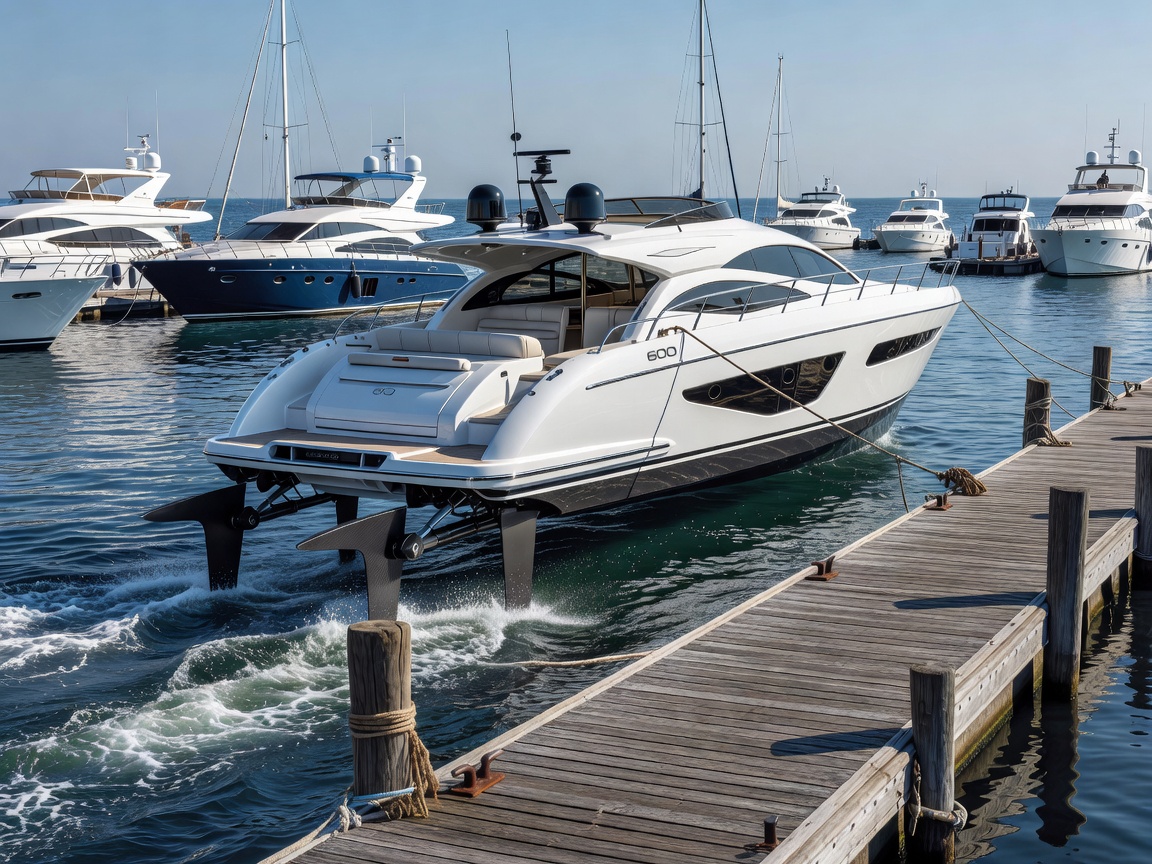
While foiling superyachts exhibit exceptional capabilities offshore, they face significant hurdles as they approach land. A vessel designed to fly three meters above the water naturally requires extensive underwater appendages. When the yacht returns to a displacement mode for harbor maneuvers, those foils plunge deep beneath the hull, fundamentally altering the vessel's draft and beam profile.
The Draft Dilemma
A 30-meter foiling yacht might cruise with a mere one-meter hull draft when stationary. However, its fixed T-foils could extend an additional four meters downward. This five-meter total draft makes accessing shallow bays, popular coastal anchoring spots, and legacy marina berths nearly impossible.
To circumvent this, naval architects have developed sophisticated retraction mechanisms. There are two dominant approaches:
- Vertical Retraction: The foil struts pull straight up into heavy, watertight trunk boxes integrated into the hull. This preserves the vessel's beam but consumes massive amounts of interior cabin space, effectively bisecting lower deck arrangements.
- Swing/Articulating Retraction: The foils hinge at the hull and swing outward and upward, completely removing them from the water. While this preserves interior space and completely eliminates underwater fouling, it massively increases the vessel's beam (width). A yacht that normally fits a standard slip may suddenly span two or three slips when its foils are raised, resulting in extreme docking fees and logistical headaches.
Dry Docking and Maintenance
Standard travel lifts and dry docks are designed to cradle traditional V-hulls or flat-bottomed displacement profiles. Slings can easily crush delicate carbon fiber trailing edges or become entangled in complex T-foils.
Foiling superyachts require specialized lifting infrastructure. Marinas servicing these vessels must invest in customized lift cradles that clear the foil struts, or utilize specific lifting hardpoints built into the deck. Furthermore, anti-fouling maintenance becomes a critical obsession; even a millimeter of barnacle growth or marine slime on a hydrofoil can disrupt laminar flow, dramatically reducing lift and triggering early cavitation.
Shore Power and Charging Constraints
Because many foiling vessels rely on hybrid-electric drivetrains to offset the massive torque required for take-off, they house immense high-voltage battery banks. Legacy marinas equipped with standard 50-amp shore power connections are vastly inadequate for rapid recharging.
A new wave of marine infrastructure is emerging, bringing high-capacity DC fast-charging to the docks. Similar to automotive superchargers, these marine charging pylons deliver hundreds of kilowatts, allowing hybrid foilers to recharge their reserves in hours rather than days, ensuring rapid turnaround for zero-emission coastal cruising.