In standard superyacht construction, naval architects have historically been afforded a generous weight budget. Solid marble countertops, heavy hardwood bulkheads, and thick fiberglass layups are industry standards. Foiling changes this paradigm completely. To achieve lift, a foiling vessel must adhere to aerodynamic principles closely related to aerospace engineering. Weight is the enemy of flight.
Carbon Fiber Reinforced Polymers (CFRP)
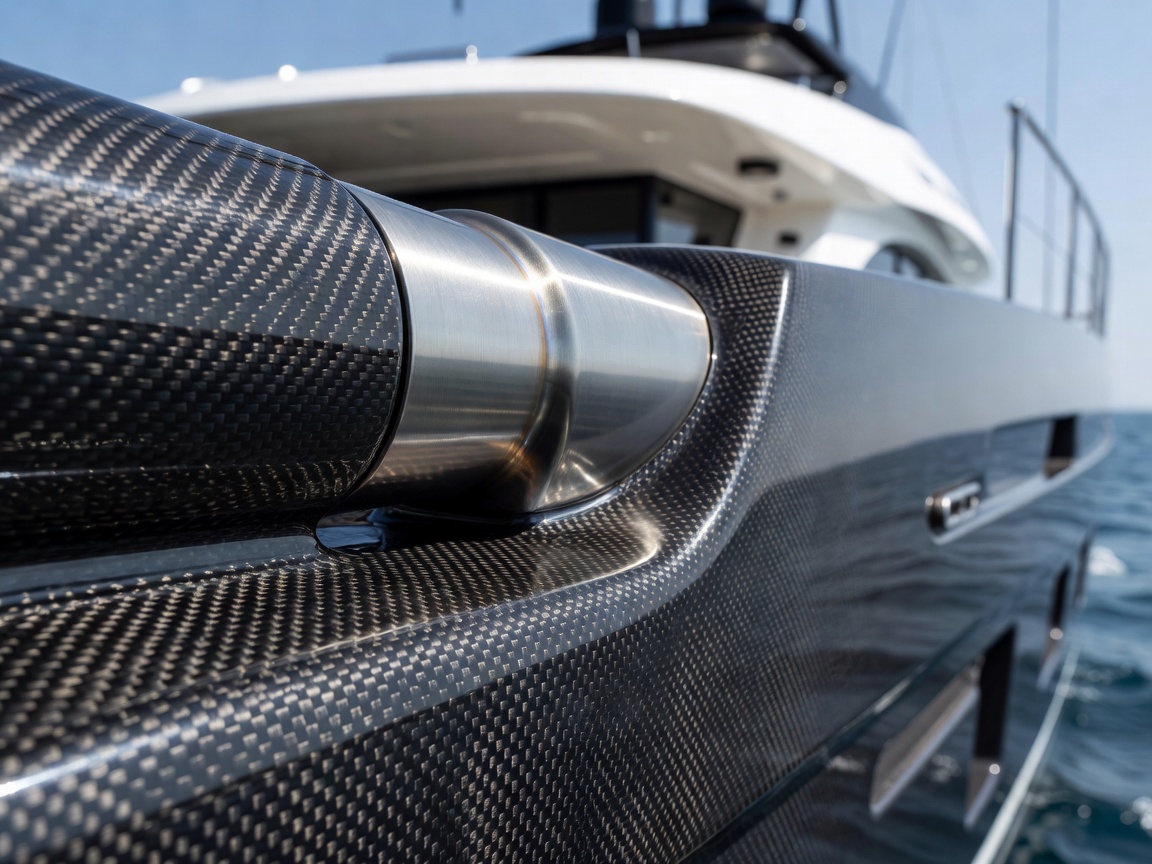
The transition to foiling necessitates a shift away from traditional fiberglass and steel toward advanced aerospace composites. Carbon Fiber Reinforced Polymers (CFRP) form the structural backbone of any modern foiling yacht. By utilizing pre-impregnated (pre-preg) carbon fiber cured under pressure in high-temperature autoclaves, builders can achieve a hull that is significantly stiffer and up to 40% lighter than standard composites.
This stiffness is not merely a luxury; it is a structural necessity. When a yacht is flying, the entire weight of the vessel is supported by three or four relatively small attachment points where the foil struts meet the hull. The shear loads and torsional stress placed on these nodes are immense. If the hull flexes under load, the geometry of the foils changes, immediately destabilizing the flight software.
Titanium and High-Tensile Alloys
While carbon fiber excels in large structural panels, it can be brittle at high-stress intersection points, such as the hinges of retractable foil mechanisms. For these critical components, engineers rely on aerospace-grade titanium (such as Ti-6Al-4V) and advanced stainless steel alloys. Titanium provides the ultimate combination of high tensile strength, relatively low weight, and absolute immunity to saltwater corrosion.
These metal components are often machined using 5-axis CNC routers from single solid billets to ensure perfect structural integrity without the microscopic flaws introduced by welding or casting.
Re-Engineering the Luxury Interior
The strict weight budget of a foiling yacht heavily impacts interior design. Solid marble vanity units and dense oak paneling must be abandoned. Instead, interior designers employ specialized lightweighting techniques:
- Honeycomb Veneers: Natural stone and rare woods are sliced down to millimeter thicknesses and bonded over ultra-lightweight Nomex or aluminum honeycomb cores. To the touch and eye, a table appears as solid granite, but it weighs 80% less.
- Structural Furniture: Rather than bolting heavy sofas and beds into the cabin, furniture is increasingly molded directly into the carbon hull structure during lay-up, serving double duty as structural bulkheads and seating.
- Optimized Wiring and Plumbing: Copper wiring is heavy. Advanced yachts use multiplexed digital switching networks to drastically reduce the total length and weight of copper cables running through the vessel.
Aerodynamic Hull Shaping
Finally, because the hull spends its time out of the water, its primary resistance profile shifts from hydrodynamic to aerodynamic. The decks and superstructures of foiling yachts are increasingly shaped in wind tunnels. Swept-back pilothouses, faired deck fittings, and teardrop-shaped superstructures ensure that headwind resistance does not drain the energy efficiency gained by lifting the hull out of the sea.