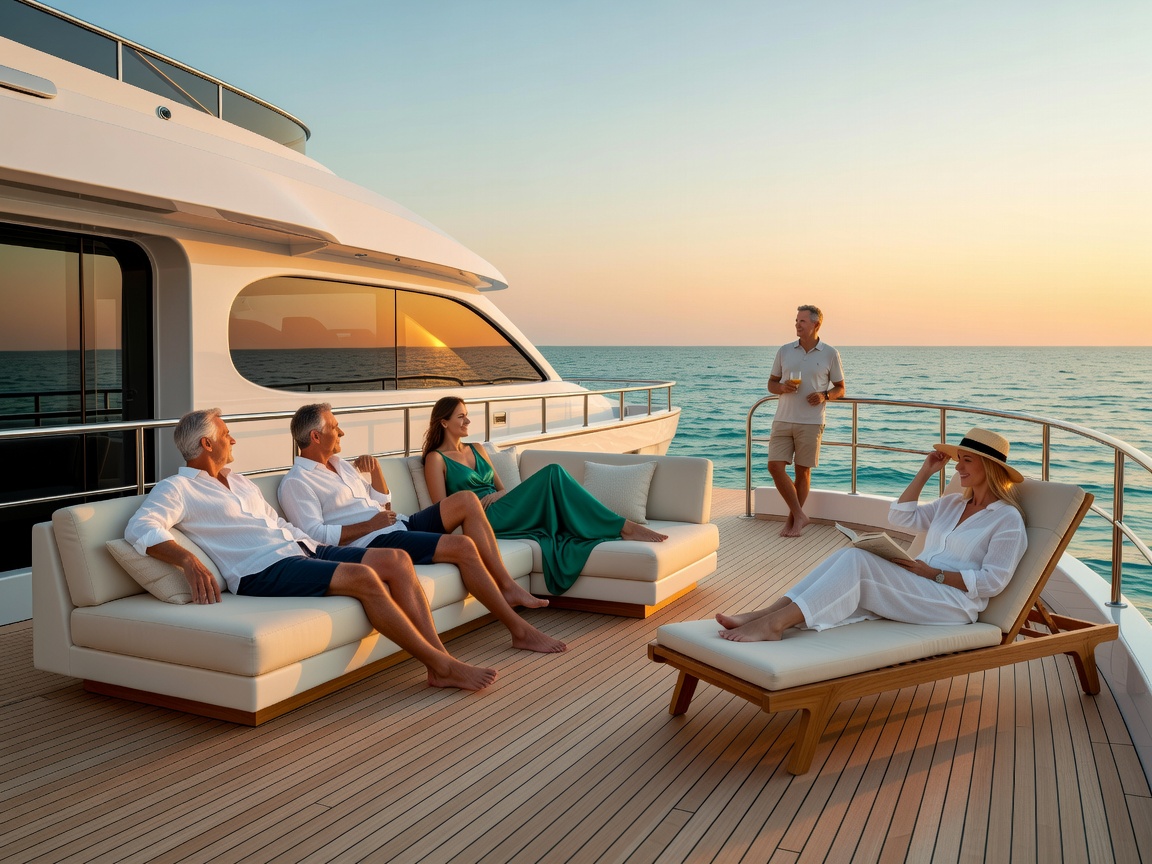
Traditional superyacht design involves an inherent compromise between speed and comfort. When a standard hull pushes through choppy conditions, the passengers experience the brunt of the kinetic energy transfer. Slamming, rolling, pitching, and heaving lead directly to discomfort, fatigue, and sea sickness. Foiling technology fundamentally alters the passenger experience by severing the yacht's connection to surface turbulence.
Flying Above the Waves
The primary mechanism for improved comfort is clearance. By elevating the hull one to three meters above the water's surface, a foiling yacht simply lets the waves pass underneath. So long as the wave height does not exceed the length of the foil struts (the vessel's "ride envelope"), the hull remains entirely isolated from the water's impact.
This isolation eliminates the sharp "slamming" typically felt when a planning hull re-enters the water after launching off a wave crest. The ride transitions from jarring to eerily smooth, often compared to the sensation of traveling in a high-speed train rather than a traditional boat.
Active Ride Control
Clearance alone is not enough to guarantee a perfect ride. Fully submerged T-foils require constant adjustment to maintain stability. This necessity is turned into a luxury feature through Active Ride Control (ARC) systems. These computer-driven arrays use forward-looking sensors, ultrasonic altimeters, and internal gyroscopes to read the sea state ahead of the vessel.
When the computer anticipates a swell, it independently actuates the trailing-edge flaps on the port, starboard, and aft foils. If a wave threatens to roll the yacht to port, the port flap increases lift in milliseconds to perfectly counteract the force. The result is a deck that remains aggressively level regardless of crosswinds or off-axis swells.
Acoustic Insulation and Vibration
Beyond motion sickness, ambient noise and mechanical vibration are primary contributors to passenger fatigue on long passages. Displacement and planning hulls transmit the acoustic energy of crashing water directly through the composite hull into the cabins.
Foiling acts as a massive acoustic isolator. Because the hull is not striking the water, hydrodynamic noise drops drastically. Furthermore, in hybrid-electric foiling setups, the combustion engines can be shut down entirely during coastal passages, or they are required to work far less strenuously than they would in a displacement configuration. This leads to dramatically lower decibel levels in the master suites and saloons, allowing guests to speak at normal conversational volumes even while traveling at 35 knots.
The Ride Envelope Limit
It is crucial to understand the limitations of comfort in a foiling vessel. The "ride envelope" is defined by the strut length. If the vessel encounters sea states with waves taller than the struts, the hull will begin to strike the crests, re-introducing slamming forces. In these extreme conditions, the captain must drop the vessel off its foils and operate it as a standard displacement yacht until conditions improve.